
Solar panels in Finland: does the investment pay off in winter darkness?
Do solar panels make financial sense in Finland's long winters? Yes — but a typical 3.3 kWp system produces 2,800 kWh per year and pays for itself in roughly 14 years. Here's what the real numbers show.
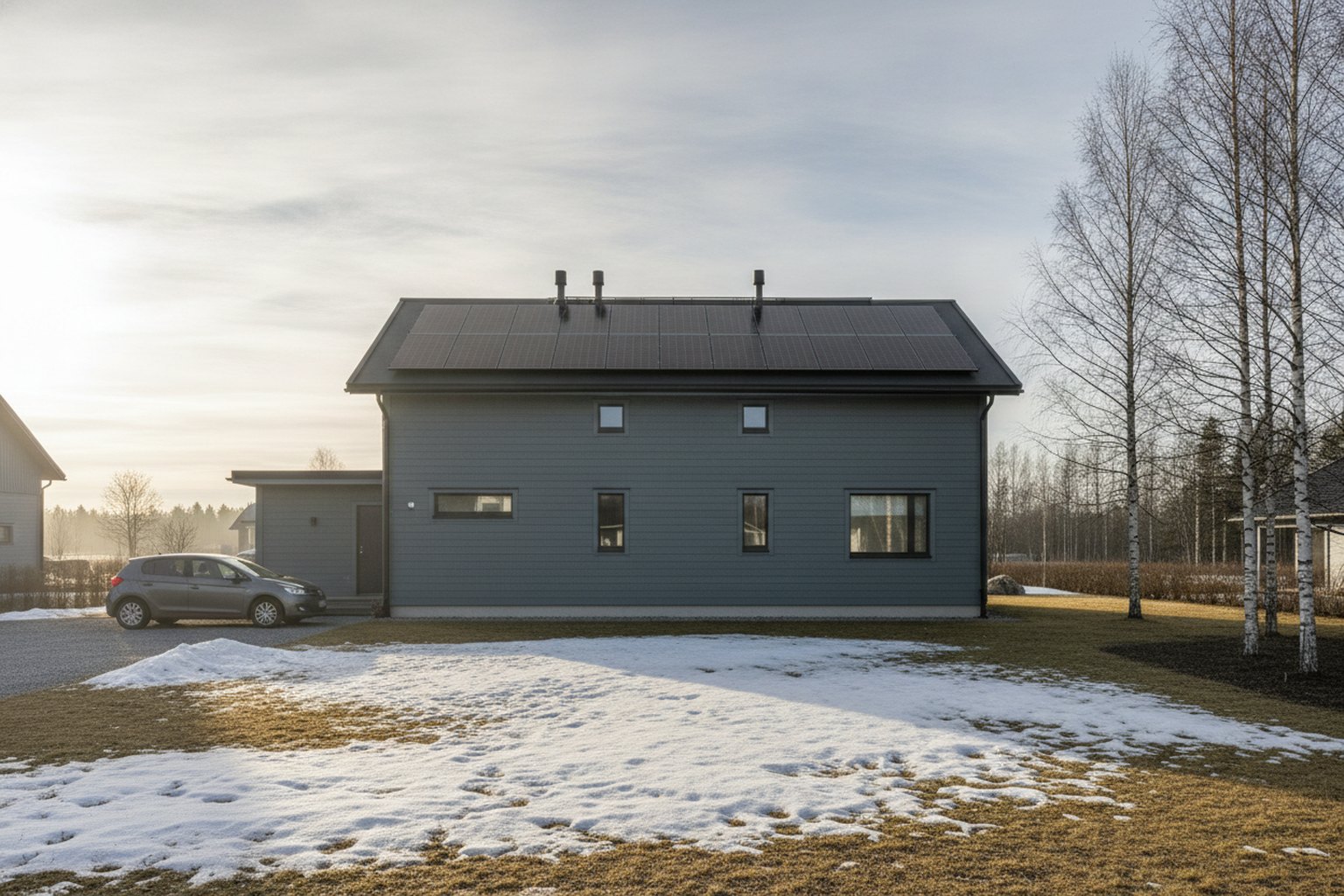
Every spring, the same question circulates on Finnish electricity and energy forums: "Does solar make sense in Finland when winter is dark for months?" The skepticism makes sense. In winter, solar output drops to almost nothing. But the payback calculation is not driven by winter alone — it's driven by what you avoid paying when the sun does shine, and that asymmetry changes the entire outcome.
The winter darkness myth, and why it's not the real calculation
The psychological barrier is real: Finland's December and January daylight averages 5–6 hours. A solar panel on a December afternoon in Turku produces perhaps 5–10 percent of its summer peak. Small wonder people think "this won't work." But payback period isn't just about winter output — it's about the differential between what you save in summer and what you lose in winter. And that differential is where solar becomes viable in Finland.
According to Motiva, Finland's national energy advice authority, a well-sized residential solar system (3–4 kWp) in central Finland produces 2,700–2,900 kWh per year. That annual production is concentrated: 70 percent of it arrives between April and October. Winter months contribute only 8–10 percent of annual yield. But here's the key point: the price you avoid paying varies by season. Summer electricity is cheaper. Winter is expensive. A 2 kWh summer self-consumption (when you use your own solar production directly) avoids a cheaper price (roughly 3 c/kWh wholesale). A 2 kWh winter self-consumption avoids an expensive price (roughly 8–12 c/kWh wholesale). This asymmetry makes smaller, well-positioned systems more cost-effective than oversized installations.
A real example: the Ekenäs household and their payback timeline
One of the most detailed case studies in Finnish solar comes from Helen, Helsinki's utility. An Ekenäs household (southwest Finland, lat. 60°N) installed a 3.3 kWp system in 2023. Here's what they achieved:
| Metric | Annual Value | Notes |
|---|---|---|
| System size | 3.3 kWp | 10 panels, roof-mounted, south-facing |
| Annual production | 2,800 kWh | Actual output, accounting for snow loss and system degradation |
| Self-consumption rate | 65–70% | The household uses 65–70% of their solar output directly (the rest is exported) |
| Self-consumption value | €265–300/year | Avoiding grid purchase at spot price (13 c/kWh avg., unsubsidized) |
| Export revenue | €25–40/year | Exporting remainder at wholesale (3 c/kWh) |
| Total financial benefit | €290–340/year | Self-use + export combined |
| System degradation | 0.5% per year | Standard for modern panels |
| Estimated payback | 14–16 years | Installation cost €12,000–15,000 (2023), no subsidies |
Why is a 14–16 year payback viable? Because a residential solar system in Finland lasts 25+ years. After 14 years of covering costs, you have another 10+ years of nearly free electricity. Over a 30-year lifespan, that system generates €2,200–2,600 in avoided electricity costs and export revenue, a return of 25–30 percent on the initial investment. The payback looks long in absolute terms, but it's reasonable in terms of net life-cycle benefit.
Why smaller systems beat oversized installations
A common misconception: bigger is always better. In Finland, it's the opposite for residential solar. A 2–3 kWp system with high self-consumption beats a 6–8 kWp oversized system on ROI. Here's why:
- Self-consumption asymmetry: Your own roof consumption is worth 13 c/kWh (the price you'd pay to import). Excess export is worth 3 c/kWh. On a small system where 70% is self-consumed, you're harvesting high-value energy. On a large system where only 40% is self-consumed, you're exporting cheap.
- No battery penalty: Adding a battery storage system can extend payback by 5–8 years due to inverter losses (10–15% loss per cycle). Without battery, a smaller well-matched system is more efficient.
- Tax efficiency: Finland's tax treatment of solar income is neutral, but oversizing creates waste heat and AC losses. A right-sized system avoids that inefficiency cost.
The forum question: "What if I heat with electric and have an EV?"
One of the most asked questions on Suomi24 and technology forums in 2025–2026:
"Haluan aurinkoenergiaa, mutta minulla on sähköauto ja sulanapito. Kannattaako silti pienemmän järjestelmän ottaa?"
(Translation: "I want solar energy, but I have an electric car and electric heating. Does a smaller system still make sense?")
Suomi24 electricity forum, 2025
The answer is yes, but with nuance. An EV charger (11 kW) and heat pump (3–5 kW) load are too large for a small residential system to serve directly. A 3.3 kWp system cannot power both simultaneously. However, if you charge the EV at night (1–5 a.m., when wholesale prices are 6–8 c/kWh) and run the heat pump during the day, the solar system still delivers value by reducing daytime grid purchases. The actual payback extends by 1–2 years compared to a home with no EV, but it remains viable. Motiva's 2024 solar guide confirms that EV + heat pump owners still see 16–18 year paybacks with correctly sized systems.
What about subsidies and government incentives?
Finland's subsidy landscape for solar has shifted. As of 2026, the national feed-in tariff has ended, and most support comes at the municipal level. The Finnish Tax Administration allows a 50% depreciation deduction in the first year for small commercial systems, but residential homeowner systems do not qualify (they're treated as private property improvements). However, some municipalities (e.g., Helsinki, Tampere) offer direct grants of €500–2,000 per installation. Check with your local municipality for current rates — they change annually.
Without subsidies, payback in central Finland is 14–18 years. With a €1,500 municipal grant, payback drops to 13–15 years. Subsidies help, but the economics work without them.
What does "power degradation of 0.5% per year" mean for your long-term returns?
All panels degrade over time. Industry standard is 0.5% annual power loss. On a 3.3 kWp system, that means:
- Year 1: 3.3 kWp (100%)
- Year 10: 3.14 kWp (95%)
- Year 25: 2.92 kWp (89%)
After 25 years, the system produces 89% of its original output. This is why payback period (typically 14–16 years) is designed to account for degradation. The system reaches breakeven before significant power loss kicks in. Fingrid and Energiavirasto both publish long-term degradation studies confirming that quality modern panels (IEC 61215 certified) maintain warranty output for 25+ years.
My take: solar is for stable homeowners with 10+ year plans
If you plan to stay in your home for at least 15 years, solar makes economic sense in Finland — even without subsidies, even with winter darkness. The payback period is longer than in sunnier countries (Spain: 8–9 years; Germany: 10–12 years), but the long-term return (25–30 year lifespan) makes the math work. The real barrier isn't climate — it's commitment. If you're unsure you'll be in the same house in 2040, the payback risk rises.
The optimal system for most Finnish homes is 3–4 kWp, south-facing, without battery. That size aligns with typical household midday load and avoids the oversizing trap. If you have an EV and want to leverage it, install a 7–11 kW charger with a timer (€1,500–2,500), not additional solar panels. The EV becomes your "battery" — you charge it at night when electricity is cheap and export/avoid costs when solar is running.
Sources
- Motiva: Solar design guide and payback calculations — residential systems (Tier A)
- Helen: Residential solar installation case studies and performance data (Tier B)
- Finnish Tax Administration: Depreciation rules for solar installations (Tier A)
- Energiavirasto: Panel degradation and warranty standards (Tier A)
- Fingrid: Rooftop solar integration and grid impacts (Tier A)
- Väre: Solar installation costs and ROI tracker (Tier B)
- Finnish Association of Municipalities: Municipal solar subsidy programs (Tier A)