
Smart EV Charging Apps in Finland Compared — Tibber, Fortum Tarkka, Helen
Finland has four main smart EV charging apps. In this comparison, only Tibber and Fortum Tarkka support OCPP chargers, Helen Lataus is tied to Helen contracts, and Synergi VPP pays for flexibility. Here's which app suits you.
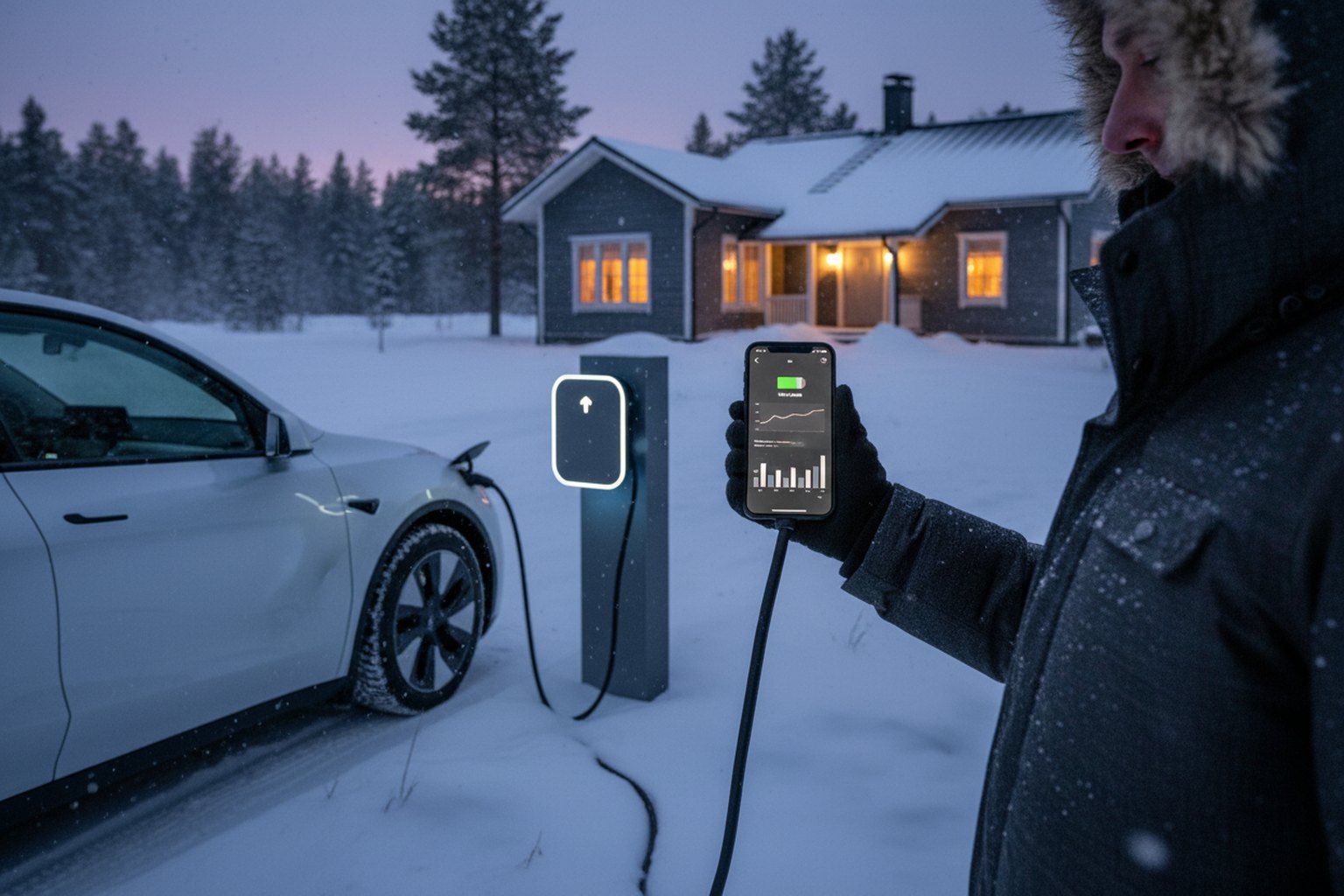
Smart EV charging apps are heavily promoted in Finland, but comparisons are rarely unbiased. Technically: a smart EV charging app controls the vehicle's charging time to avoid electricity price spikes. In practice, the app turns on the charger when electricity prices are cheapest. This can save 200–400 euros annually for a Nissan Leaf owner charging at home daily. But not all apps are the same, and not all chargers are compatible. According to Fingrid statistics, Finland had approximately 120,000 electric vehicles at the end of 2025, and about 40% of their owners had adopted smart charging.
This article compares four main smart EV charging apps: Tibber, Fortum Tarkka, Helen Lataus, and Väre smart charging. We also cover Synergi VPP, which is a virtual power plant service, not strictly an app. For each, we examine what electricity contracts they require, which chargers (wallboxes) they support, their monthly costs, and how well they work. At the end, I'll share my perspective: whether to switch immediately or wait.
What can you save with smart charging? Let's calculate for a Nissan Leaf owner
The Nissan Leaf is one of Finland's most popular electric vehicles. Battery capacity is 62 kWh, average consumption 250 Wh/km. The owner charges at home every night, approximately 15,000 km annually, which equals 3,750 kWh of charging energy per year (with typical charging efficiency ~85%, 15,000 km requires roughly 3,750 kWh of supplied energy).
Using 2026 Q1 Nord Pool prices for the Finnish region (FI):
- Cheapest hour (00:00–02:00): approximately 5–6 c/kWh
- Mid hour (08:00–16:00): approximately 8–10 c/kWh
- Peak time (17:00–21:00): approximately 12–15 c/kWh
- Annual average price for spot electricity: approximately 8 c/kWh
If the owner charges manually in two different ways:
- Manual charging to the next cheapest hour (without app): 3,750 kWh × 9 c/kWh = €337.50/year
- Smart charging to the 8–10 cheapest hours overnight: 3,750 kWh × 5.5 c/kWh = €206.25/year
- Savings: approximately €131 per year, or €11 per month
This isn't a huge saving if the app costs €10 per month. It becomes worthwhile only if the app is free or costs less than €3 per month.
Tibber — European app, OCPP support, free app
Tibber is a Norwegian company offering spot electricity contracts and smart charging in Finland, Sweden, Norway, and Germany. The app is free. The Tibber Pulse meter costs approximately €199 but includes a wireless home energy sensor showing real-time whole-house consumption.
The Tibber app supports all OCPP 1.6 and OCPP 2.0.1 chargers. These include popular models: Easee, Zaptec, Wallbox, Cozify, and many others. The app automatically optimizes charging, but users can also set manual limits, for example, "charge maximum 50% on weekdays."
A Murobbs forum user wrote in April 2026:
"I used Tibber for half a year. The app works, but it's not perfect — if you want charging to start after a certain time, you have to calculate the percentage yourself to keep the car manageable until morning."
Murobbs user, electric car section 2026
With Tibber, your electricity provider depends on location. Easiest path: join Tibber network, get a new meter from them for free, and the app starts optimizing your charging immediately.
Fortum Tarkka — Finnish-owned, bundled with Fortum Charge & Drive
Fortum Tarkka is owned by Fortum and works only with Fortum Charge & Drive home chargers, which cost approximately €1,490 installed. The app itself is free for Fortum Charge & Drive customers. Fortum also offers a spot electricity contract (Fortum Spot).
Users cannot use Fortum Tarkka with other charger brands — it's a proprietary solution. The app optimizes charging to avoid spot price spikes, just like Tibber.
A question from Suomi24's electricity section (2026) reads:
"Fortum Tarkka is good, but I bought it when I didn't know Tibber existed. Now I get the same savings without app costs."
Suomi24 user, electricity section 2026
Fortum Tarkka is an excellent choice for those already invested in Fortum Charge & Drive chargers. Setup is simple, and support is localized in Finland.
Helen Lataus — Convenient, but tied to Helen contracts
Helen Lataus is part of the Helen Electricity Contract service. It costs €6.90 per month and is available to all Helen customers. Helen Lataus isn't a full-featured smart charging app — it's mainly a timer showing when electricity prices are cheapest over the next 24 hours, giving users the option to turn on their charger at that time.
This means Helen Lataus requires active user participation. It doesn't adjust charging speed automatically; instead, it advises the user when to start charging. Helen does offer OCPP integration to some large customers, but for typical households, Helen Lataus is a manual app.
Helen Lataus's advantage is that it's the cheapest option and works with any charger. The downside is that it requires active monitoring.
Väre smart charging — Load balancing service in the Vaasa region
Väre (owned by Vaasan Sähköyhtiö) offers smart charging to Väre customers. It costs approximately €2.90 per month and is available only in Väre's service area. It works similarly to Helen Lataus — it's more of a scheduler than a fully automatic smart charger.
Synergi VPP — Virtual Power Plant service that pays you
Synergi VPP (Virtual Power Plant) isn't a smart charging app but a flexibility service. It makes an agreement with you: you surrender control of your car's charging times to help balance the grid. In return, Synergi pays you approximately €50 annually (source: Synergi VPP pricing 2026).
Synergi requires a smart charger and open API network access. It's an economic reversal: the typical charger owner pays costs; Synergi customers earn money. However, the amount is small and suits large EV fleets or residential housing cooperatives best.
Comparison table: which app suits you?
| App | Monthly cost | Contract requirement | OCPP support | Automation |
|---|---|---|---|---|
| Tibber | €0 | Tibber Spot (spot) | Yes, OCPP 1.6 and 2.0.1 | Fully automatic |
| Fortum Tarkka | €0 | Fortum Spot + Fortum Charge & Drive | Fortum C&D only | Fully automatic |
| Helen Lataus | €6.90 | Helen contract | No (manual timer) | Semi-automatic |
| Väre smart charging | €2.90 | Väre contract (Vaasa area) | No (manual timer) | Semi-automatic |
| Synergi VPP | −€50 (earns money) | Smart charger + spot contract | Yes, detailed API | Fully automatic |
My take: seek smart charging, but don't pay for the app
I recommend Tibber or Fortum Tarkka due to their free pricing. If you already own a Fortum Charge & Drive charger, Fortum Tarkka is an excellent choice. If not, Tibber is better because it supports all OCPP chargers and isn't tied to a single charger brand. Helen Lataus is okay if you're a Helen customer and willing to manually monitor charging.
I don't recommend paying for an app if cheap spot electricity saves you only €100–150 annually. If an app costs €7 per month, it consumes €84 of your savings, leaving net savings below €50. Synergi VPP is an exception — it pays you, not the other way around.
Sources
- Fingrid: Electric vehicle registration statistics and smart charging statistics in Finland (Tier A)
- Energy Authority (Energiavirasto): Regulations for EV charging services (Tier A)
- Motiva: EV charging guide and energy consumption (Tier A)
- Tibber: Spot electricity service and smart charging (Tier B)
- Fortum: Fortum Tarkka smart charging section (Tier B)
- Helen: Helen Lataus and charging services (Tier B)
- Väre: Väre smart charging and charging services (Tier B)
- Synergi: Virtual Power Plant (VPP) service for EVs (Tier B)