Finland's cheapest electricity in Europe 2025: four reasons it happened
Finland repeatedly landed at or near the bottom of Nord Pool's price table in 2025. Four structural factors drove it there, none of them accidental. But cheap wholesale power doesn't translate one-for-one into a cheap household bill.
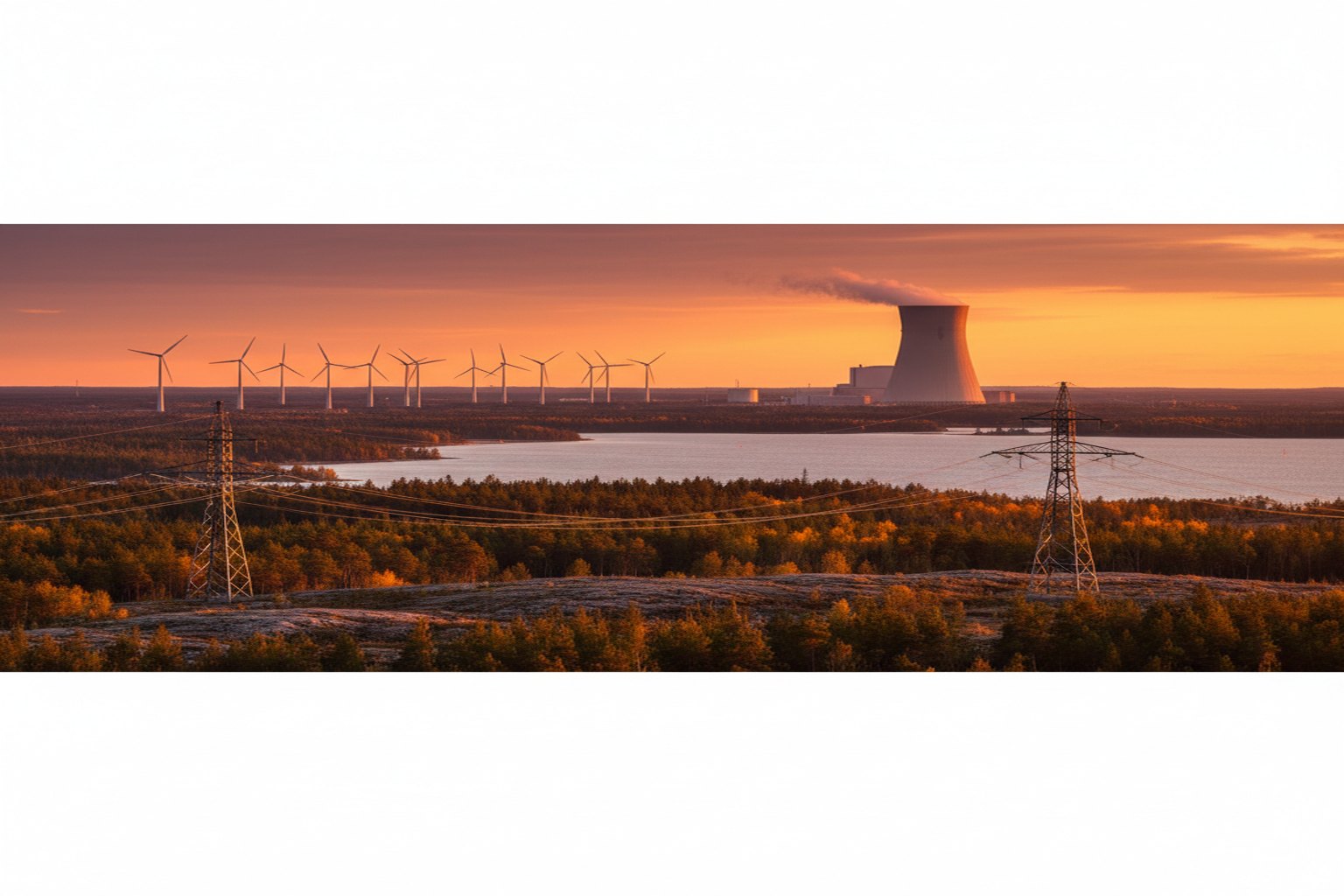
Finland ranked among the cheapest electricity markets in Europe throughout 2025. YLE reported that Finland finished as the third-cheapest EU country, and in several months the spot price was the lowest across the entire Nordic region. Only northern Sweden and Norway were cheaper, both underpinned by far larger hydro reserves. Hufvudstadsbladet wrote in the summer of 2025 that the Nordic region's cheapest electricity was found at that moment in Finland, crediting Olkiluoto 3 combined with new wind capacity.
The annual average wholesale price fell to €41/MWh, down from roughly €46/MWh in 2024. That's ~4.1 c/kWh of generation cost before distribution and tax. For context, Germany's equivalent figure stayed above €80/MWh and France's remained considerably higher.
Four factors that landed at the same time
Low prices didn't come from one source. Four structural changes coincided in the same year, and together they pushed the price down more than any of them could have done separately.
1. Olkiluoto 3 ran the full year without an unplanned outage
Finland's newest nuclear unit, OL3, completed its first full calendar year in 2025 without a single unplanned outage. That's unusual for a new reactor. According to TVO's annual results, the full Olkiluoto site produced 23.41 TWh in 2025, covering roughly a quarter of Finland's electricity consumption. OL3's share of that is around 10 TWh. Nuclear doesn't respond to weather or market prices; it delivers a constant baseload that keeps the wholesale price down even during demand peaks.
2. Wind covered nearly a third of domestic production
Wind already overtook hydro in Finland in 2024. By 2025 its share of total domestic electricity production climbed to around 28%. Fingrid's 2025 annual report confirms that 794 MW of new renewable capacity, mostly wind, was connected to the national grid in the first half of the year alone. In March 2025, Finland broke its wind generation record at an instantaneous 7,296 MW.
Wind has near-zero marginal cost. When there's a lot of it, it pushes Nord Pool market prices down. The effect shows up in negative-price hours: 2025 saw 447 hours of negative electricity prices, compared with 724 in 2024. The reduction is largely because Aurora Line started absorbing part of the surplus.
3. Aurora Line opened a new transmission corridor to Sweden
Built jointly by Fingrid and Svenska kraftnat, Aurora Line was commissioned on 12 November 2025. The new 380-kilometre, 400 kV line from Pyhansela in Muhos to Messaure in northern Sweden adds up to 800 MW of transfer capacity from Sweden to Finland and 900 MW in the opposite direction. Finnish wind surplus can now flow west rather than crashing local prices into negative territory.
4. The 2024-25 winter was milder than normal
Temperature is electricity's hidden variable. A mild winter means less heating demand. A significant share of Finland's electricity consumption is electric heating, so a few degrees of difference in outdoor temperature shows up directly in consumption and, through it, in price. January and February 2025 were a degree or two warmer than average, which dampened consumption precisely in the months when prices would otherwise rise.
From a Finnish forum: "Is there a catch?"
"Spot electricity is so cheap right now that I'm wondering whether I should switch from a fixed contract. But is there a catch -- will the price shoot up again?"
User on Suomi24 electricity forum, 2025
It's a fair question. Cheap wholesale prices don't guarantee a cheap bill going forward. All four factors above are structural, but none is permanent: OL3 can go into maintenance, wind can stop blowing for weeks, Aurora Line's cable can develop a fault, and winter can turn cold. With a spot-price contract, the customer carries all that risk themselves.
From Quora: why is electricity so cheap in Finland?
"Why is electricity so cheap in Finland? Is it the nuclear power, or something else?"
Quora user, Why is electricity so cheap in Finland?
The answer is the four-factor combination above. There's no single explanation. Nuclear explains the baseload, wind explains the negative hours and the absence of price spikes, Aurora Line explains part of the surplus absorption, and the mild winter explains the rest. Remove any one of the four and the outcome would be different.
Household example: a detached house using 20,000 kWh/year
A concretely: an electrically heated detached house in Finland typically uses 20,000 kWh per year. Here's what the 2024-to-2025 drop in wholesale price means in euros, once you add distribution and electricity tax on top.
| Component | 2024 (c/kWh) | 2025 (c/kWh) | Note |
|---|---|---|---|
| Energy (wholesale + retail margin) | ~5.2 | ~4.7 | Nord Pool FI annual average + sales margin |
| Distribution (energy charge + fixed/kWh) | ~4.5 | ~4.6 | Energiavirasto: distribution rose ~0.8% for electric-heat users |
| Electricity tax (class II household) | 2.827 | 2.827 | Fixed rate, unchanged 2024-25 |
| Security of supply levy | 0.013 | 0.013 | Increase came only in April 2026 |
2024: energy + distribution + taxes totalled roughly 12.54 c/kWh. Annual bill at 20,000 kWh: around €2,508.
2025: roughly 12.14 c/kWh. Annual bill: around €2,428. Difference: roughly €80 per year.
That's the counterintuitive finding: a wholesale price drop from 5.2 to 4.7 c/kWh produced less than €100 of annual savings for a typical household. The reason is straightforward. According to Energiavirasto's bill breakdown, the energy component accounts for only around 40% of the electricity bill. Distribution and taxes make up nearly as much again, and they don't fall when wholesale prices do.
Put plainly: cheapest wholesale electricity in Europe doesn't translate directly into the cheapest household bills in Europe. Finland's distribution tariffs are among the highest in the Nordics because the national grid serves a sparsely populated country, and the electricity tax is fixed. The actual household bill stayed near the Nordic average even when the wholesale price was at its lowest.
My view: OL3's contribution is underrated in public debate
The media focuses heavily on wind power, for good reason: its growth is fast and visible. But the single most important factor behind 2025's cheap electricity was OL3's first full, trouble-free operating year. A nuclear reactor producing 10 TWh of baseload annually without interruption does more to lower Nord Pool prices than a thousand wind turbines blowing intermittently. Wind brings prices down unpredictably and unevenly; nuclear does it steadily, around the clock. Of the two, OL3 is the more stable pillar for market prices, and it gets far less credit for it.
What this means for 2026
The starting point for 2026 is different. Aurora Line is in full operation for the whole year, OL3 continues its baseload, and new wind capacity keeps connecting to the grid. Energiavirasto reported that household electricity bills fell 2.1% in 2025, but the security-of-supply levy increase in April 2026 and ongoing upward pressure on distribution tariffs could eat into that gain before the year is out. Wholesale prices can be cheap; the bill won't follow to the cent.
Sources
- YLE: Finland had Europe's third-cheapest electricity prices in 2025 (Tier B)
- HBL: Nordens billigaste el finns just nu i Finland (Tier B)
- TVO: Olkiluoto produced about a quarter of Finnish electricity in 2025 (Tier A)
- Fingrid: Annual Report 2025 (Tier A)
- Fingrid: Aurora Line commissioned 12 November 2025 (Tier A)
- Energiavirasto: Components of an electricity bill (Tier A)
- Energiavirasto: Household electricity bill fell 2.1% in 2025 (Tier A)
- Energiateollisuus: Energy Year 2025 -- Electricity preliminary data (Tier A)
- Quora: Why is electricity so cheap in Finland? (Tier C -- user question)
- Suomi24: Electricity discussion forum (Tier C -- user question)