
Wind power and spot electricity price in Finland: what 9,433 MW means for your bill
Finland's installed wind capacity more than doubled in four years. Wind keeps average prices low — but it also creates sharper price spikes when the wind drops. If you're on a spot contract, both sides of that trade affect you.
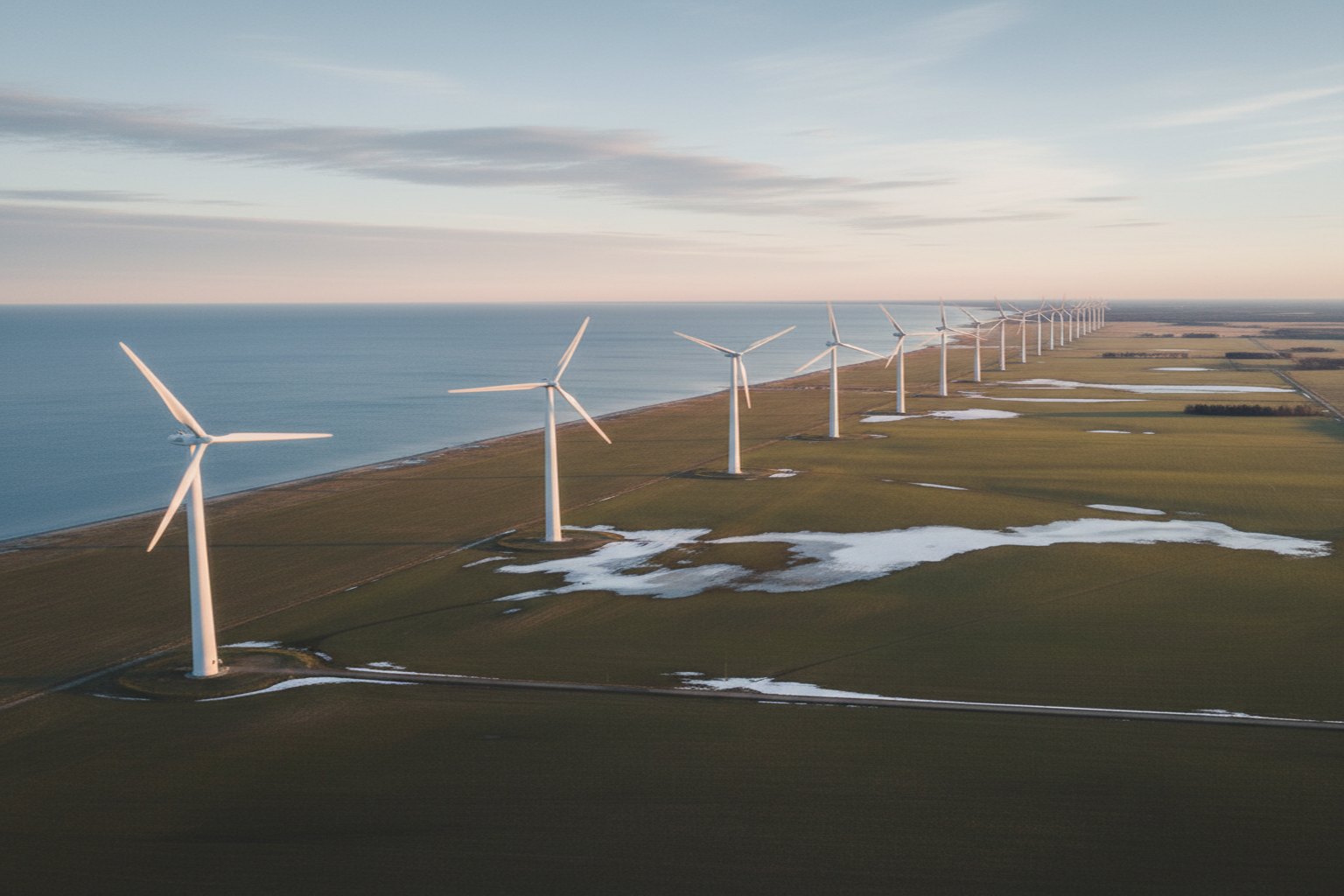
Finland's wind capacity hit 9,433 MW in 2025, up from under 4,000 MW in 2021. According to Renewables Finland's 2025 capacity report, wind covered roughly 28% of Finland's electricity consumption that year, and the share is still climbing. The short version of what this means for spot prices: more generation = lower average price. The longer version is more interesting.
Wind doesn't lower your bill equally across all consumers. The benefit flows to whoever can shift their consumption to windy hours. If your electricity use concentrates in weekday evenings or cold winter mornings, you may see almost none of it.
Where Finland's wind farms are, and why it matters for prices
Most Finnish wind capacity sits in Ostrobothnia, along the coast between Vaasa, Kokkola, and Oulu. Low-pressure systems moving in from the North Sea bring the strongest winds there, particularly on autumn and winter weekends and overnight. The live tracker at sahkovatkain.web.app shows real-time Finnish wind output relative to consumption. When wind covers more than 60% of demand, spot prices in the FI price area have historically slipped below 5 cents/kWh.
A question from the Murobbs electricity forum in 2025 captures what many expats wonder:
"Why is electricity basically free on some nights but then 15 cents on Monday morning? Is that just wind?"
Murobbs user, spot electricity thread, 2025
Mostly, yes. On weekends, industrial demand drops by 20-30%, but the wind keeps blowing just as hard. Supply outstrips demand and prices fall. By Monday morning factories restart, demand climbs, and if the wind has eased, prices can quadruple in a few hours.
Negative hours: 447 in 2025, 724 in 2024
Fingrid's electricity market information shows that the Finnish FI price area recorded 447 negative-price hours in 2025, down from 724 in 2024. Those are hours when the spot price fell below zero — generators were effectively paying to push electricity onto the grid because output exceeded demand and the network couldn't absorb more.
The drop from 724 to 447 doesn't mean wind is becoming less disruptive. It means consumption grew and new capacity came online elsewhere in the Nordics. More wind is still coming. Renewables Finland projects capacity will pass 12,000 MW by 2027. Negative hours will fluctuate but they won't disappear.
The counterintuitive finding: wind lowers the average but raises the spikes
Here's the part that rarely gets explained plainly. When wind is strong, the spot price falls toward zero. The marginal generator, often a gas plant or a regulated hydro reservoir, shuts down or ramps back. That capacity leaves the market. When the wind then drops, that capacity doesn't come back instantly. The resulting supply gap creates a sharper price spike than would have existed before all the wind capacity was built. This is called the "cannibalization effect," and Finland's Energy Authority wind power guidance includes it as a factor in market dynamics assessments.
The mofei.life blog, a resource for expats navigating Finnish bureaucracy, covered this directly in its electricity explainer:
"Why do Finnish electricity prices go negative? I thought electricity always costs something."
mofei.life, "Finnish electricity prices explained for expats," 2025
Negative prices are a market signal, not a glitch. They tell generators that there's too much supply right now, and they tell consumers that this is the cheapest moment to run anything that draws electricity.
Monthly wind share in 2025
Based on Statistics Finland's energy figures and Fingrid production data, wind's monthly share of Finnish electricity output varied as follows in 2025:
| Month | Wind share (%) | FI spot avg (cents/kWh) |
|---|---|---|
| January | 34% | 7.2 |
| February | 31% | 8.1 |
| March | 30% | 6.8 |
| April | 27% | 4.3 |
| May | 22% | 3.1 |
| June | 18% | 2.9 |
| July | 15% | 4.7 |
| August | 16% | 5.2 |
| September | 21% | 6.9 |
| October | 29% | 7.4 |
| November | 33% | 9.1 |
| December | 36% | 8.6 |
Source: Fingrid production data + Statistics Finland energy statistics 2025. Spot prices are FI area monthly averages, excl. VAT.
The inverse relationship is clear in winter but weaker than you might expect. December had the highest wind share (36%) but also the third highest average price (8.6 cents/kWh). Winter heat pumps and electric heating push demand to its annual peak even as turbines spin at capacity. Wind alone doesn't overcome that demand pressure.
A worked example: Saturday night in Ostrobothnia
A family in Seinajoki has an electric car (60 kWh battery, 11 kW charger), a ground-source heat pump (3 kW compressor), and an electric sauna (6 kW kiuas). On Saturday night from 02:00 to 06:00, wind output on the Fingrid live feed shows 7,200 MW against a national consumption of 6,800 MW. The spot price sits at 0.8 cents/kWh.
Over those four hours, the family uses:
- Electric car: 11 kW x 4 h = 44 kWh (full charge)
- Heat pump: 3 kW x 4 h = 12 kWh
- Sauna: starts at 05:30, 30 minutes to heat = 3 kWh
Total: 59 kWh
Energy cost at 0.8 cents: 59 x €0.008 = €0.47
The following Monday morning, 07:00-11:00, wind has dropped. Output is 2,100 MW against demand of 10,200 MW. Spot price: 10.0 cents/kWh. The same 59 kWh would cost: 59 x €0.10 = €5.90.
The difference is €5.43 for identical consumption, just timed differently. If the family runs this Saturday-night schedule four times a month, that's around €21 in monthly savings on energy alone, before transmission and electricity tax.
What this means for fixed-price contracts
A fixed-price contract removes the volatility completely. If you pay 9.5 cents/kWh flat, a windy Saturday night doesn't reduce your bill. Your supplier carries the market risk and prices it into the contract rate.
Whether spot or fixed is better depends almost entirely on whether you can shift consumption. An EV with a charging timer, a heat pump on a night tariff, or even a washing machine set to run at 03:00 all benefit from spot pricing during high-wind periods. Without any scheduling ability, spot pricing during winter peak hours can be more expensive than a fixed contract.
My view: wind is good news for spot buyers — but only for half of them
Finland's wind expansion is a real advantage for spot-contract households that can schedule their large loads. The savings in the example above are genuine and repeatable. For a household without any timing tools — someone renting a flat without a smart meter or EV, heating by district heating — the benefit shows up only as a slightly lower annual average, and that's real too, just much smaller.
As capacity heads toward 12,000 MW by 2027, the market will have more sub-1-cent hours and more 15-cent hours. A flat average that looks reasonable hides a wider spread underneath. Knowing when your consumption happens matters more than it used to.
Sources
- Renewables Finland / Finnish Wind Power Association: Wind power in Finland 2025 capacity report (Tier A)
- Fingrid: Open production data — wind power hourly output in Finland (Tier A)
- Fingrid: Electricity market information — negative-price hour statistics 2024-2025 (Tier A)
- Finnish Energy Authority: Wind power guidance — market dynamics and cannibalization effect (Tier A)
- Statistics Finland: Energy supply and consumption 2025 — monthly production shares (Tier A)
- Sahkovatkain.web.app: Live wind power output vs. consumption tracker (Tier B)
- mofei.life: "Finnish electricity prices explained for expats" — Q&A on negative prices (Tier C)
- Murobbs, spot electricity thread 2025: user question on wind and price volatility (Tier C)