
Why do Finnish electricity prices go negative — and what does it mean for you?
Finland recorded 447 hours of negative electricity spot prices in 2025. Seeing a minus sign in the app doesn't mean money arrives in your account. This article explains what's actually happening, why it occurs, and whether it's worth shifting your consumption to those hours.
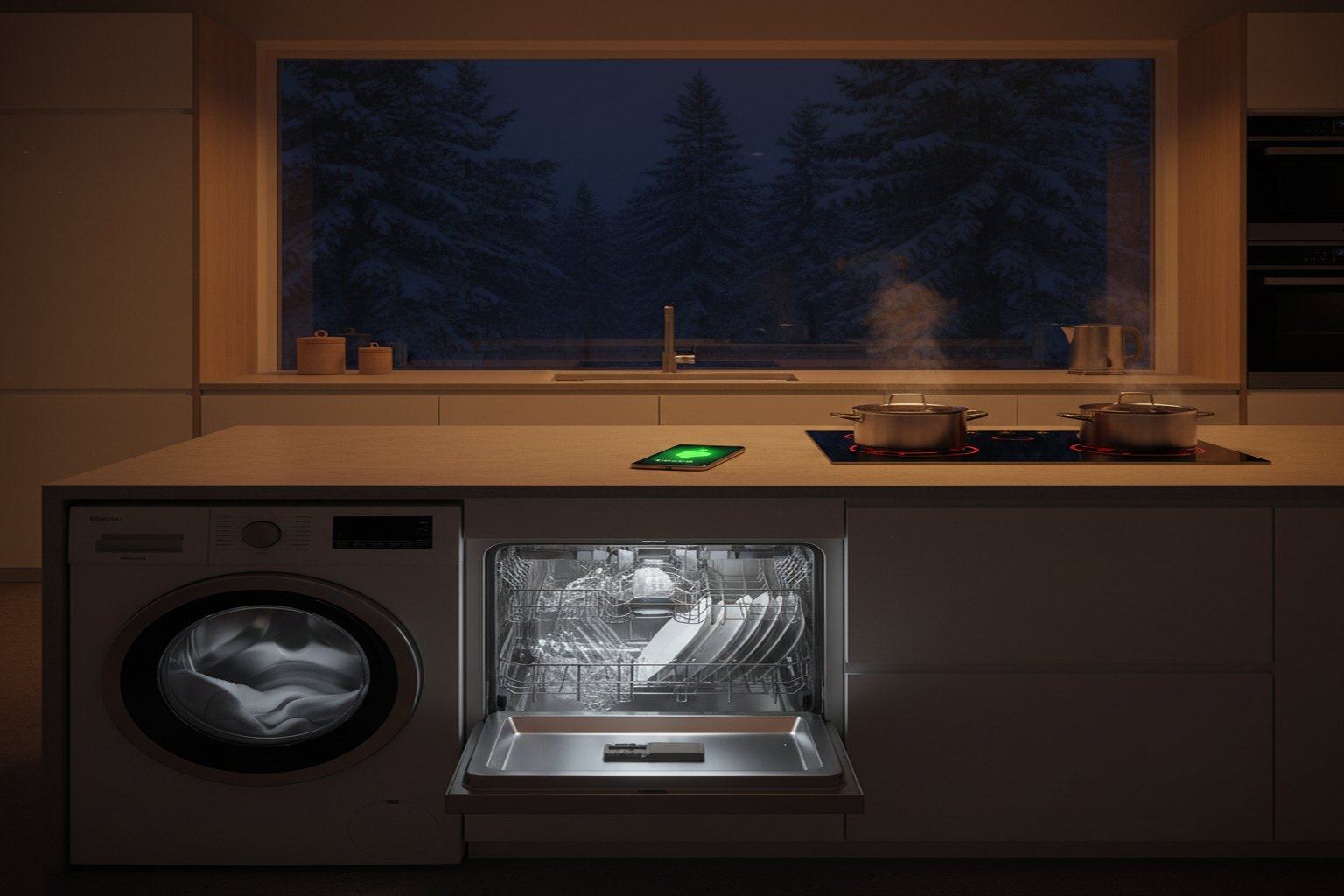
The spot price of electricity in Finland (the pörssisähkö / porssisahko rate) turned negative 447 hours during 2025, down from a record 724 hours in 2024. Finland has led Europe in this statistic for several years running. If you have a spot-price contract and use an app like Fingrid's Tuntihinta to track prices, you've probably seen the minus sign and wondered what it means in practice. Here's the straight answer.
Why does the spot price go negative?
The electricity spot price is set by Nord Pool's day-ahead market, where producers submit sell offers and buyers submit buy orders. The market-clearing price is where offered supply meets accepted demand for each hour. When supply outstrips demand at a zero price, the clearing price can fall below zero, down to the technical floor of -€500/MWh that Nord Pool has set as the limit.
In Finland, this happens most often overnight or on weekends in windy weather. By the end of 2025, Finland had 9,433 MW of installed wind capacity, up from under 4,000 MW in 2022. A wind farm doesn't simply stop when prices drop. Producers may accept a negative clearing price rather than shut down and restart equipment, particularly when they have feed-in support or long-term contracts that make curtailment expensive.
Nuclear adds to the pressure. Olkiluoto 3 runs at roughly 1,600 MW around the clock. Ramping it down quickly isn't straightforward, so during low-demand hours the combined output from wind and nuclear can exceed what the grid needs. Yle reported in 2023 that Olkiluoto 3 cut output specifically because prices had fallen so far.
The 23 November 2023 trading error
The technical floor of -€500/MWh became widely known on 23 November 2023 when prices hit that floor for an entire afternoon. Bloomberg reported that Kinect Energy AS had submitted sell orders for roughly 5,787 MW of electricity that didn't actually exist, caused by a unit conversion error (kilowatts entered instead of megawatts). The average price that day fell to -€203/MWh. Energiavirasto (the Energy Authority) launched an investigation. That day was an anomaly, but it illustrated exactly how the mechanism works at its extreme.
Do you actually get paid?
This question comes up constantly. The short answer from an expat who checked their own bills and wrote it up:
"Do I get paid if the price is negative? Not quite. Even when the spot price component is negative, the transmission fee and electricity tax stay, so the total cost simply drops. You just pay less, not less than zero."
Mofei.life, Finland electricity pricing explained
Your electricity bill has three components. First, the energy charge, which reflects the spot price your supplier uses. This can turn negative. Second, the siirtomaksu (transmission fee), paid to your local grid company, Caruna, Helen Electricity Network, or whichever monopoly operates the wires in your area. This is always positive. Third, sähkövero (electricity tax), set by the state. In household tax class I it was 2.253 cents/kWh in 2025. These two fixed costs mean that even at deeply negative spot prices, your total cost per kilowatt-hour almost never reaches zero, let alone goes below it.
Worked example: what does a negative-price hour actually cost?
A household is running three loads simultaneously in the early hours: an EV drawing 4 kWh to complete its charge, a heat pump consuming 6 kWh, and a hot-water heater pulling 3 kWh. Total: 13 kWh in one hour. The spot price is -0.3 cents/kWh.
| Component | Rate | Consumption | Cost |
|---|---|---|---|
| Spot energy | -0.3 c/kWh | 13 kWh | -€0.039 |
| Transmission fee (example) | 4.0 c/kWh | 13 kWh | €0.520 |
| Electricity tax (class I, 2025) | 2.253 c/kWh | 13 kWh | €0.293 |
| Total | 13 kWh | €0.774 |
Transmission rates vary by grid company. 4.0 c/kWh is a representative figure for southern Finland. Figures exclude VAT for clarity.
The energy component saves you less than 4 euro cents on this entire 13-kWh block. The total bill doesn't go negative. What it does do is make those 13 kWh substantially cheaper than during peak hours, when the spot component alone might run 8-15 c/kWh.
How often do negative hours actually occur?
The 447 hours in 2025 represent roughly 5% of the year. Fingrid's own analysis concluded that negative hours are a structural feature of Finland's market rather than a curiosity, driven by a combination of abundant hydro from the Nordic region, fast-growing wind capacity in Finland, and the inflexibility of large baseload units. Energiavirasto's 2025 report on consumption timing noted that increased demand response from households actually reduced the number of negative hours below earlier projections. More households shifting consumption to cheap hours is evening out the extremes.
When do negative hours tend to occur?
Most negative hours cluster between midnight and 6 AM, particularly on Saturday and Sunday nights in spring (April to May) when snowmelt swells hydro output and wind speeds are high but industrial demand is low. They also appear on stormy autumn nights. You can check tomorrow's prices via Fingrid's open data API or the Tuntihinta app; if the forecast shows negative prices overnight, you can set your appliances accordingly.
Should you shift consumption to negative-price hours?
My view: yes, if you already have a spot-price contract and your appliances support timers, do it. If you're considering switching contracts specifically to capture negative hours, the math probably doesn't justify it on its own. Here's why.
The saving on a single hour of washing-machine use at a deeply negative spot price is around 10-30 euro cents compared to an average-priced hour. Over a year, even if you catch 200 such hours, that adds up to perhaps €20-60 saved on the energy component alone. The savings are real but modest. Where it compounds meaningfully is with a large EV battery or a heat pump running continuous overnight loads. A heat pump drawing 6 kWh/h over six cheap hours represents 36 kWh, and the spot-price difference between a negative hour and a 10-cent hour is €3.60 for that single night. Do that 50 times a year and you're looking at €180 on the energy component alone.
The counterintuitive part worth sitting with: negative electricity pricing in Finland does not mean the electricity grid is broken or that prices are out of control. It means the market is working exactly as intended. Producers with fixed costs prefer selling at a loss over shutting down. Consumers who can respond to price signals reduce the frequency of those negative hours over time. Energiavirasto's data shows this mechanism is already operating: more flexible consumption in 2025 reduced price extremes at both ends.
Sources
- Suomen Uusiutuvat ry: Wind power statistics 2025, Finland 9,433 MW (Tier A)
- Fingrid-lehti: Is a negative price the new normal? (Tier A)
- Energiavirasto: Consumption timing affects nearly half of all household bills, 2025 (Tier A)
- Energiavirasto: Household electricity bill fell 2% in 2025 (Tier A)
- Nord Pool: How is the electricity price calculated (Tier A)
- Energiavirasto: Investigation into the 23 November 2023 trading error (Tier A)
- Mofei.life: Finland electricity pricing explained — expat perspective (cited)
- Bloomberg: Trader error causes huge plunge in Finnish power prices, 23 Nov 2023 (Tier B)
- Yle: Finnish nuclear plant throttles production as electricity price plunges (Tier B)
- Helen: Negative electricity price explained, 2025 (Tier B)